All posts by melindacousins

Misogyny, bravery, hashtags, and speaking up (a follow up to #YesAllWomen)

I’ve been a little bit overwhelmed by the response to my recent blog post asking how the church can respond to #YesAllWomen.

For starters, a number of people called me “brave,” which while I can understand and appreciate, hasn’t sat very well with me. I guess ultimately because it saddens me that I live in a culture where naming the reality of this experience is rare enough, and can bring enough negative response, that to do so is considered courageous.

I’ve had the opportunity to reflect further on why this is, and I recognise that I am part of the problem. When experiences like I named in my post happen, whether to me or to others, I still tend to respond to them as if they are anomalies, one-offs. Perhaps I don’t say anything because I wilfully forget that they are happening all around me, often to women much younger than I who have much less influence and ability to speak up about it.

My awareness has been raised to the point that I have thought through what I am going to say when (not if) I am in a situation where a woman or girl is being touched or spoken to inappropriately. No more looking back and thinking “I wish I had said something,” or “I was so shocked I didn’t think quickly enough to say something.”

I am so grateful for the incredibly positive responses I have had to my post. What has been particularly pleasing is the way this conversation has been picked up offline in a number of ways. It’s easy to be “outraged” on the internet, and some question the value of hashtags and blogs as “slacktivism” – a replacement for activism that might make us feel better, but doesn’t actually change anything. I’m hopeful that #YesAllWomen is much more. In this case, simply raising awareness is in and of itself “doing something.”

I’m grateful for all the women who have told me “I never realised it wasn’t just me,” and for all the men who have said, “I’m so shocked, how did I not know about this?” Now that we are all more aware, my hope is that next time we see something like this happening, we will all speak up. Men in particular, if you hear other men catcalling women, or making jokes about rape, please ask them to stop. If you see a woman in a situation where she looks uncomfortable, ask her, “Is this man making you uncomfortable?”

I’m incredibly humbled by the women who have shared with me their horrific stories of abuse. Given what I said above, I won’t call them “brave,” but I will call them important, honourable and gracious. 

I’m thankful too for the (male) pastors in my family of churches who have asked how we can continue this conversation into the future. While I’ve always been a little hesitant to be pigeonholed as a ‘spokesperson’ for women, if God has given me the opportunity and influence to bring this issue into the light, I am going to grab it with both hands. This is not a “women’s issue.” It is a leadership issue, a culture issue, a church issue, and a gospel issue.

Finally, I was reminded again yesterday, powerfully and publicly, why #YesAllWomen exists, and needs to exist, in the church. Christianity Today’s online Leadership Journal published a six-page article in which a convicted rapist, writing from jail, was given a platform to explain his actions – which he did by characterising his sexual abuse of a child as a “relationship,” lamenting the consequences he has faced since being caught without once taking ownership of what he had done to his victim. The article was tagged by the editors with the words “Adultery” and “Mistake.” (These have since been removed. They have not been replaced by “Rape” or “Crime.”)

[If you don’t know what I’m referring to and want to, see Tamara Rice’s excellent post].

What has been encouraging is the response of so many men and women, calling for CT to #TakeDownThatPost, another hashtag that has so far caused Leadership Journal to add a disclaimer, and then edit the article (not particularly well). I’m still hopeful they will respond by deleting it, but the conversations it has provoked among a number of high profile Christian leaders about misogyny, victim-blaming, and minimising abuse, demonstrate that when we listen to one another, when we become more aware, we learn and grow and things can change. And if it takes a hashtag to help that process along, well, God has used stranger methods.


Update: about an hour after I posted this, Christianity Today responded to #TakeDownThatPost by deleting the post and apologising for publishing it. So pleasing, and so good to see an internet apology that is not, “Sorry you were offended by us,” but rather, “Sorry, we did the wrong thing and we should not have.”

Today would be a good day to be at Oxford

Perhaps some people who are new to my blog might find it a bit strange that I alternate between serious posts on social, theological or political issues … and well, travelogues. But I’ve often said two of the things I’m most passionate about are God’s Word and God’s world – and I’m always keen to explore how those intersect with my life and the issues of those around me. So today is Monday again, and therefore as I often do, I’m imagining a place I have previously visited and what it would be like to spend the day there today.

Img2006-04-28-0021

I have lots of study to get done this week as I am heading off on some real life travels shortly. So today is just a short post for inspiration. If anywhere should encourage study, it’s Oxford!

Img2006-04-28-0002

What did I love about Oxford?

All the Universities I have studied with have been great places of learning, but as relatively young institutions they just don’t have the “hallowed halls” of places like Oxford.

Img2006-04-28-0007

My sister and I spent the day at Oxford a few years ago, and there was certainly a sense of being in another time, imagining life as a scholar in this place.

Img2006-04-28-0014

It’s hard not to wonder about all the great thinkers who have passed through these doors throughout the centuries.

Img2006-04-28-0010

I’d love to spend the day in just one of the libraries, discovering all the ideas and passions of those who have written in the areas I am interested in. For me, one of the joys of study is getting to “meet” people through their books!

Img2006-04-28-0016

What did I learn from Oxford?

I am reminded why I am a lifelong student: because I love learning. I love discovering new ideas, sharing ideas with others, thinking about things differently, asking questions and seeking a range of possible answers, imagining new ways of doing things, and considering how I might be able to change my small corner of the world.

Img2006-04-28-0006

Going back to study since lecturing has also helped me have some sympathy for the struggles of students – yes, sometimes it is hard to stay motivated, and sometimes it is hard to see how some things you are learning will make a difference to your life.

Img2006-04-28-0018

But I have been to too many places around the world where education is denied to many, particularly young women, to take my studies for granted. Learning is a great privilege, and it can be part of both growing in understanding and being formed in character, if we let it.

Img2006-04-28-0004

I also believe education brings a responsibility. I don’t study to amass knowledge for myself, but rather to be better equipped to teach and share and engage with others in ways that are helpful, inspiring and challenging, that they too might engage more thoughtfully with God’s world in whatever way they are called and equipped to do so.

Img2006-04-28-0013

It’d be lovely to be learning at Oxford today, but really, it doesn’t matter if you are in a famous institution or in the school of life, or somewhere in between – if you are reading this it is likely that you have the opportunity to learn something today! I’d encourage you to be grateful for the privilege, and to consider the responsibility it brings to share with others as you can.

How does the church respond to #YesAllWomen?

I remember the conversation so vividly. I was seventeen, it was a Saturday morning in summer, and our youth group was clearing the garden of an elderly church member. Taking a break, I found myself sitting cross-legged in a circle on the grass with five other young women around my age. I don’t remember how the conversation started, or who said something first. It wasn’t a topic we had talked about before, nor was it one we ever mentioned again. But someone was brave enough to share her experience of being groped by one of the guys in our group – not asked for, not consented to. Someone else told a similar story, then someone else. And for the first time in my life, I realised that this kind of thing wasn’t something that had just happened to me, or to a couple of us, or even to most of us. It was the experience of us all.

Every. Single. One.

So when #YesAllWomen started trending on twitter last weekend, I was immediately taken back to that conversation all those years ago. And I was reminded once again that my group of friends were not an anomaly, but that this is the common experience of everyone who grows up female in our society.

I realise that the immediate context for the twitter conversation was a specific instance of violence, and I realise that not all men are perpetrators of harassment and violence against women, but it exasperates me that I have to name those as caveats, because as far as I can tell, no one is suggesting otherwise. But too often this kind of conversation is derailed by those kinds of responses. No, not all men are like this. But when enough are to make this the experience of yes, all women, then surely it’s time to have an open conversation about it.

For Christians, it is easy to think these things happen to women “out there,” but not to the women in your church. That is a mistake. I could tell you story after story of women I know, but part of the point of #YesAllWomen was to hear women speak their own experiences. And so while I have hesitated to do so, for any number of reasons, let me tell you just a few of mine.

The guy in my youth group who repeatedly grabbed my breasts while playing rough games. The young man who heard me speak on a Christian radio program and emailed me to tell me what he would like to “do to me.” The man who got my number from the church bulletin and phoned me in the middle of the night with sexually explicit threats. The “sweet old man” at church who backed me into a corner and shared details of the dreams he had about me while stroking my hand.

I’ve never told anyone most of those stories before. They are awkward and embarrassing and to be honest there is still a part of me that feels like saying them out loud will make people think I’m making a big deal out of nothing. But the truth is my experience is the same as nearly every woman I know. This is the culture in which we live.

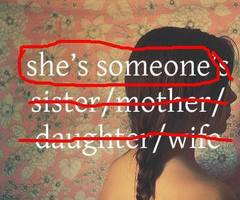
She's Someone

And all of these stories I told took place within the context of the church. The community called to model the Kingdom of God, where peace and justice and love are to be demonstrated. If anywhere should be a place safe from harassment and violation, surely it should be here.

So how does the church respond to the reality of a culture which is marked by everyday sexism and sexual harassment of women? Where all kinds of bad behaviour is minimised as “boys being boys” and women are expected to laugh it off or be flattered? Where many women, myself included, are afraid of being labelled strident trouble-makers for even mentioning this topic?

I’ll be honest. I’m a leader in the church and I struggle to know how to respond to this. I’m a woman in the church and most of the time I try to forget that this is how it is.

But maybe, like the twitter conversation, we need to start by being frank and open about this. How can we even begin to reach out to our community with a message of hope and healing, if we are not willing to name the reality of our experience? If we are not willing to call out what Tara Moss eloquently called the “toxic silence”? (for which she has since received rape threats).

I would say to pastors and preachers, leaders in the church, both men and women, read the #YesAllWomen conversation, and as you read, picture the women in your church speaking. How will that reshape the way we preach, teach, and care?

Beyond responding within our own community, I love the question Suzanne Burden concludes her excellent blog on this topic with:

“What if the Church started leading the way culturally in decrying injustice against women and raising them up as image-bearers of God for his good purposes?”

Let me end by saying I don’t know what happened to all of those girls in that circle that summer morning. I do know that by the time we were 20, one of the six had been raped and another physically assaulted, both by young men they met at church. The one in three statistic borne out in reality, not “out there,” but in our own community. How is the church responding to that?