
Tag Archives: Bible

Learning hospitality from Bedouins … or Today would be a good day to be in Wadi Rum

rocks

Monday morning and I’m back into routine, but today I’m thinking about a place about as far away as possible, in the middle of the Jordanian desert. Most tourists to Jordan visit Wadi Rum for a day, zooming through the wilderness in the back of a jeep, and I’ve done so twice in the last few years. It’s a place made famous not only because the Hollywood movie Lawrence of Arabia was filmed here, but because it is the real place British army officer T E Lawrence spent time during World War I. It’s also in the vicinity of where the Israelites travelled from Sinai to the Promised Land, and perhaps one of the easier places to imagine the kind of landscape they experienced during their wilderness wanderings.

landscape

What did I love about Wadi Rum?

Wadi Rum is a place of wide open spaces. The sandy desert is surrounded by majestic rock formations, giving a sense of being cut off from the rest of the world.

open space

It has a breathtaking beauty in its starkness.

sand hill

The colours of the sand and rocks are incredible in their diversity.

sand colour

It is easy to imagine the past in a place like this, particularly as reminders of those who came before and their way of life are all around.

Ancient writing carved into rock caves

It is a place where the locals live simply, with many things not having changed for thousands of years.

shepherd

What did I learn from Wadi Rum?

The local Bedouins welcome visitors to the area, and share something of the life they and their forebears have enjoyed in this place for centuries.

Vehicles ancient and modern

The key practice of the Bedouins that is demonstrated with simplicity and clarity is hospitality. The welcome of the stranger as a friend, the invitation to share, making what they have available with open hands.

tent in desert

The Bedouin honour code requires even enemies to be provided with food and shelter for three days. In such a harsh place, where survival is on the line, generosity and hospitality are shown in ways not so common in places where we have so much. Too often we think hospitality is about putting a good ‘show’ rather than genuinely inviting people to share what we have as they have need.

rocky desert

The Old Testament was written in this part of the world, and one of its pervasive underlying metaphors is of God as our host. The God who invites His people to eat at His table, to shelter in His dwelling place, to share His home, and to find protection in His blessing. We can miss the power of this picture if we miss the importance of hospitality to the original cultural context.
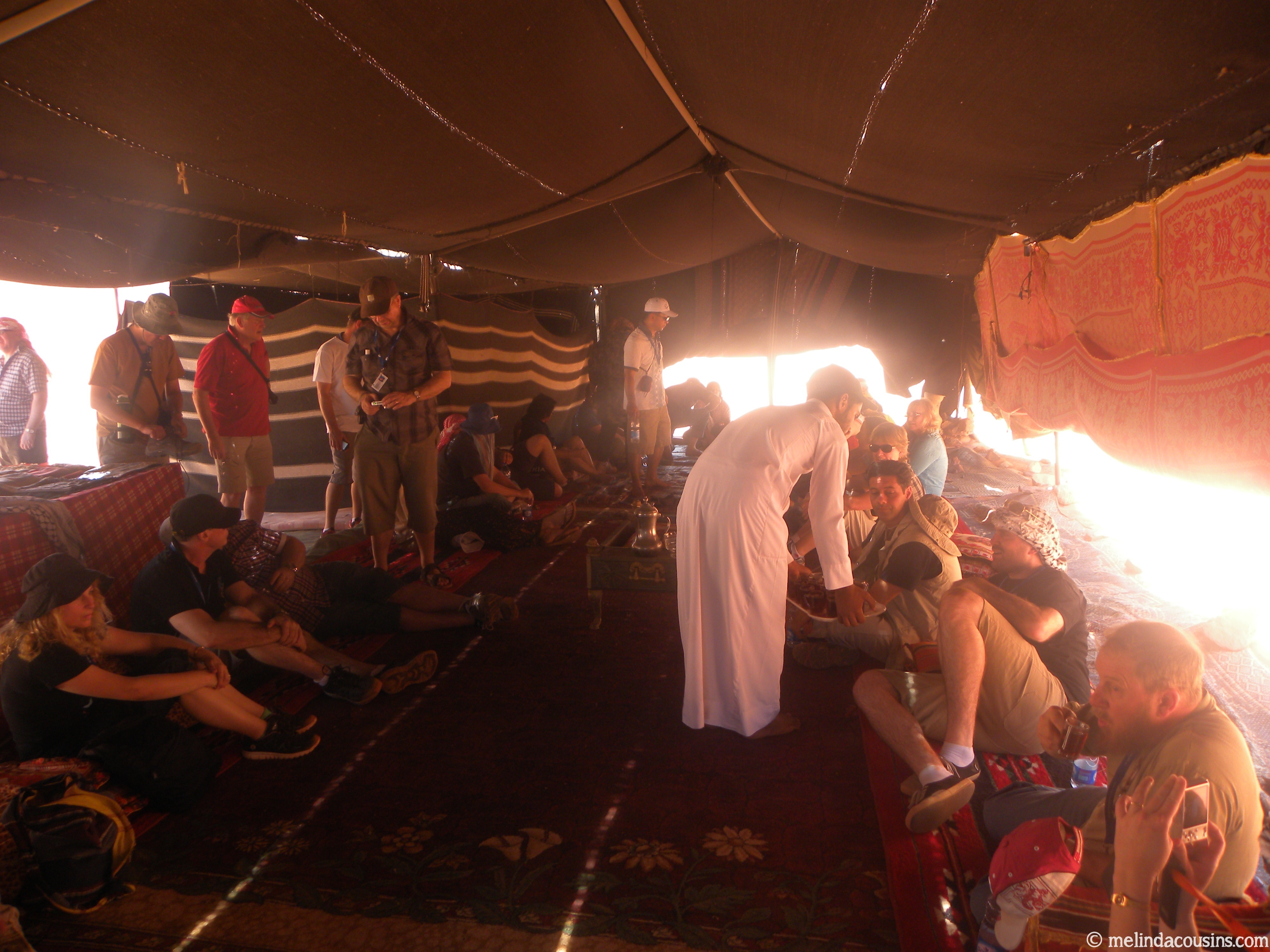
bedouin tent

The people we met in Wadi Rum taught and reminded us of the great gift of hospitality, a gift which is not dependent on appearances, resources or wealth, but on a generous heart and a willingness to invite someone into our lives, treating them not as an alien or stranger, but a friend and neighbour.

bedouin girl in tent

They showed me again a picture of the love God has for me as He invites me into His family, and the love He calls me to show to my neighbours, strangers and even enemies.
Can we please stop saying “Charity begins at home”?

Slide2I was recently forwarded an email by an older, distant relative complaining about the “injustice” of huge amounts of foreign aid being given to other nations while Australian pensioners struggle to get by. The closing words of the email, the “clincher” to prove the point that we should stop giving “so much” away, was that old saying, “Charity begins at home.”

Now the fact that my country has recently drastically decreased its foreign aid giving and completely abandoned the commitments we have consistently made over the last 30 years to play our part in addressing world poverty is a subject for another post! Today, I want to take a closer look at that supposed “trump card” saying.

Because I’ve also noticed its use on social media.  When someone advocates for greater foreign aid spending, it doesn’t take long for someone else to reply that it is more important to care about a group in need in our own nation, and to pull that same supposed clincher, “Charity begins at home.”

Is it just me, or do the people who say “Charity begins at home” usually seem to be implying that they think it should end there?

Here are my problems with the phrase ..

1. It’s a false dichotomy

Slide1The assumption seems to be that if I care about the global poor, I don’t care about people doing it tough here in Australia; as if I can only care about one thing at a time. But compassion is not a zero sum game.

I don’t believe I have to make a choice between the two and I don’t believe our nation needs to either. We need to stop assuming that standing up for one cause means you don’t care about any others.

2. It’s a false equivalence

I don’t want to get bogged down in ‘ranking’ needs, but to me there is a qualitative difference between people struggling to afford the costs of living in Australia and people dying of preventable diseases because they don’t have access to clean drinking water or basic sanitation in other parts of the world. I understand that I am generalising here, and I know there are people in my own backyard who are doing it tough, but mostly I think that our perspective is a little off.

Just for one example, the current Australian single pension is $751 per fortnight.  We have widely available free health care and education. On the other hand, 1.3 billion people in developing countries live on less than $7 per week, 768 million people do not have access to safe drinking water and over 1 billion have no access to basic sanitation.

In 2013, the Australian government spent 27 times as much on welfare/social security as it did on foreign aid. Whatever you think about the adequacy of Australian unemployment or pension rates, I think it is clear we are not comparing apples and apples here.

3.     The saying is not biblical

The first use of the phrase “Charity begins at home” in print is found in Thomas Browne’s 1642 book Religio Medici. It is now quoted as if it was gospel truth, often by Christians, and it is surprising how many people claim it is biblical or “based” on the Bible. It’s not.

In fact, my reading of Browne is that he is arguing against the saying. He uses it twice, in these two sentences:

  • “Charity begins at home, is the voice of the World…”
  • “That a man should lay down his life for his Friend, seems strange to vulgar affections, and such as confine themselves within that Worldly principle, Charity begins at home.”

 Read it for yourself and see what you think.

The Bible itself is pretty clear that we are called to love not just our family and our neighbours, but even our enemies. [Matt 5:44] The Old Testament laws laid a foundation for justice and generosity for the marginalised, including widows, orphans and foreigners. [e.g. Deut 15:7-11]

4.     That’s not what that proverbial saying means

More to the point, and I’m happy to be corrected on this, but my understanding is that the saying as it was originally taken up as a general English “proverb” was meant to refer to the fact that virtues are cultivated in the every day – that is, we learn to be compassionate and charitable people at home; that capacity within us as human beings begins to develop there, and then grows as we exercise it outside the home.

It’s worth noting that the word charity at that time didn’t mean what we usually assume it means today. It is the word the King James Version uses to translate the Greek αγαπη or love in the famous 1 Cor 13 passage. So “love begins at home” might be better, meaning again that ideally we learn love from our families so that we can then exercise it in our interactions with others outside the home.

What we usually mean by charity today (donating to the needy) actually doesn’t make any sense with the saying – providing for the welfare of the people in your house is by definition NOT charity!

So … this is my question for today, and I’m aware that it is idealistic and unlikely … but whatever debates we have about generosity, global poverty, foreign aid, and caring for the needy at home, can we at least stop pretending that the saying “Charity begins at home” is some kind of magic bullet that trumps all rational discussion?!

Some post-Christmas questions

And so Christmas is over for another year. What are we left with? Do the joy and wonder continue? Do we have greater peace and gladness than we had three days ago?

Or are there some feelings of disappointment, that after all the build up it was over so quickly, or that it didn’t quite go as we had hoped and planned? Or perhaps there’s just sheer relief that the craziness of the past few days is finally over and we can sit down and relax! Maybe we’ve already moved on to thinking about New Year’s Eve and the next celebration to plan and prepare for and the seemingly endless cycle starts again.

I love celebrating Christmas but many years I am left with these kinds of questions afterwards. What difference does it make to today and tomorrow and the next day? Is it really all just about one day?

I knew that the word “Christmas” itself is a contraction of “Christ’s Mass,” but what I didn’t know before is that the word “mass” comes from the Latin missa which is in the concluding words of the liturgical celebration. These are the words of dismissal, the words of sending out, the words of mission. That has got me thinking today. Christmas is not just about one day, but a sending out into what comes next.

Of course that is also true of the original Christmas story. It is the celebration of a birth, which is not an end itself, only the starting point for the life that follows.

This Christmas I am struck with the message the angels had for the shepherds – words which also point forward and have a sense of dismissal or commissioning to them.

 “On earth, peace to humanity, for whom God has goodwill.”

(Luke 2:14, my own translation)

What does it mean to go forward knowing that God has goodwill toward us? That He is pleased with us? That He favours us and is for us? What does it mean in a world where so many people think God is against them, just waiting to smite them? Where His church has too often given them the impression that God is displeased with them?

These are the questions I am asking today, as I move forward into a new year and all that it holds. How do I take the mission of Christmas with me? How am I making it known that God loves this world – every broken, hurting, vulnerable corner of it? How does that make a difference to my every interaction and thought, my every word and deed?