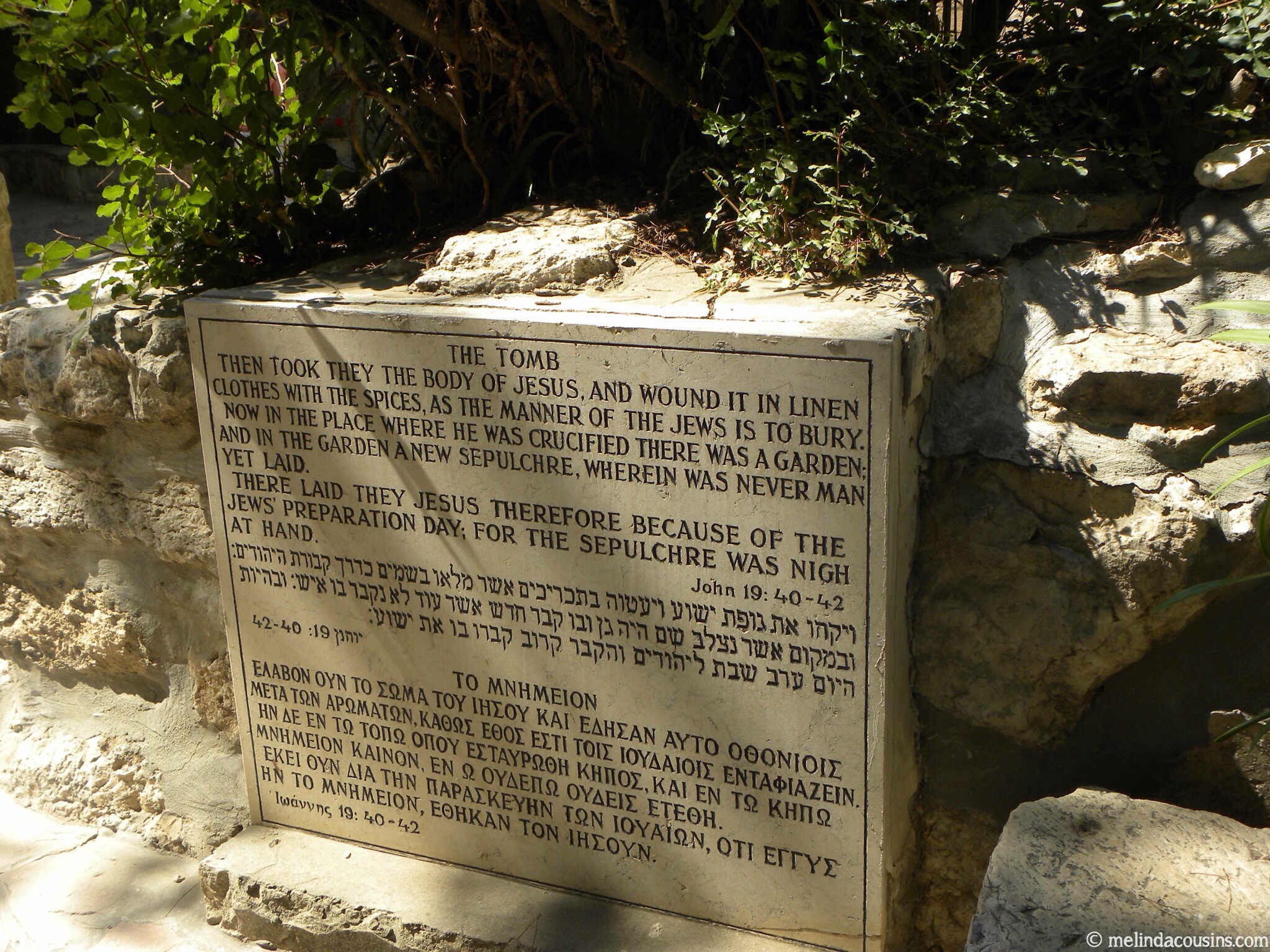
Resurrection Sunday. Easter. The weekend we celebrate the turning point of history, the fact that everything from then on is different, because Jesus was raised to new life. Although I’m sure actually being at the Garden Tomb just outside the current Old City of Jerusalem would be crazy busy at this time of year, today is a great day to reflect on visiting that beautiful place.
The Garden Tomb is a peaceful oasis in the midst of the bustling city; a good place to sit and reflect on what happened, whether here or somewhere nearby.
The traditional site of Jesus’ tomb and thus resurrection is inside the Church of the Holy Sepulchre, inside the walls of the Old City. But many have noted that it doesn’t totally fit the historical story, and looked for an alternative site.
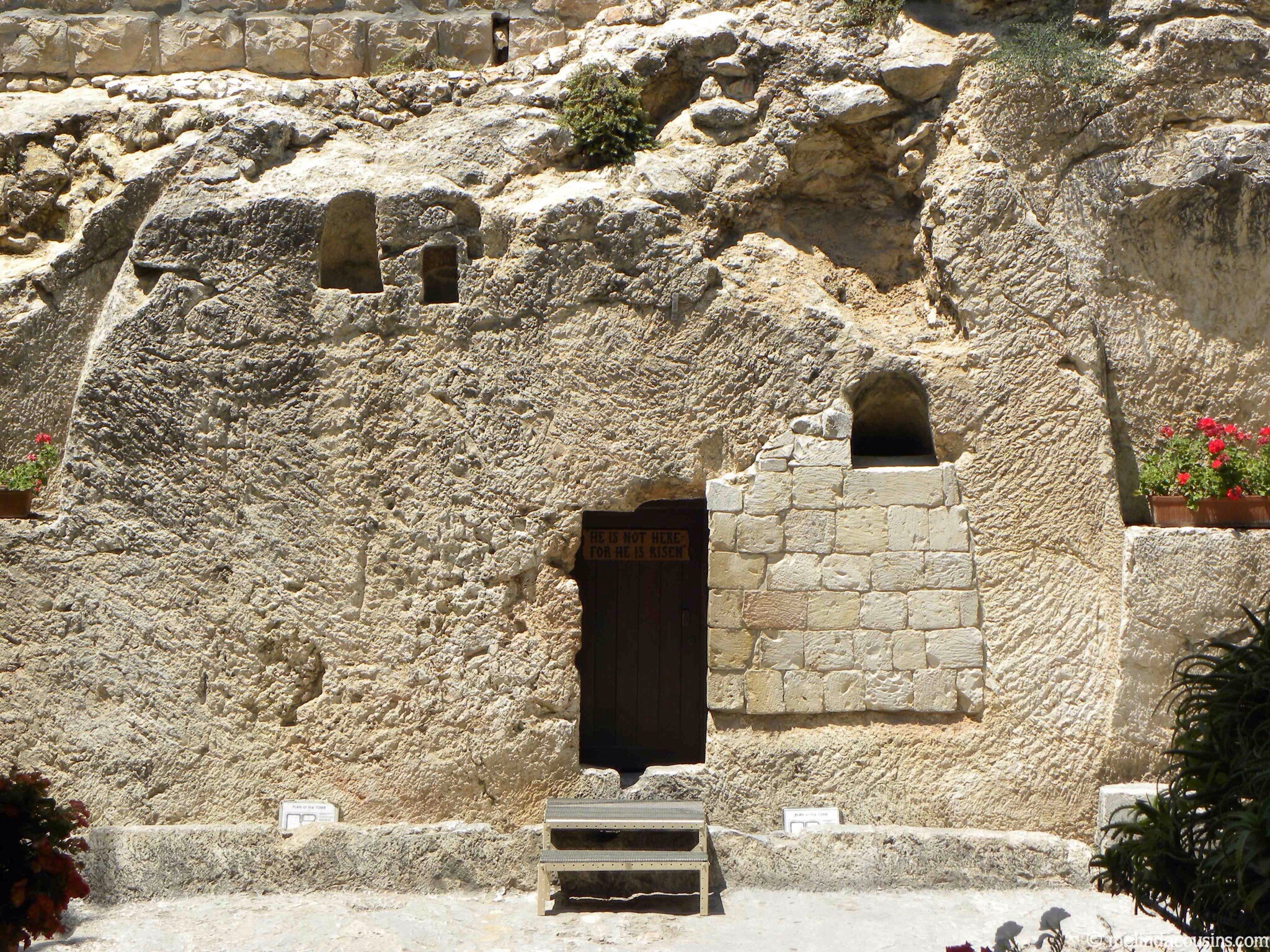
The Garden Tomb was discovered in the 1860s, and has many features which meet the description of the kind of tomb in which Jesus’ body was laid. It is hewn out of the rock, and has a channel in front for a stone to be rolled to close it.
Inside there is a burial chamber as well as a weeping chamber for mourners.
A large cistern and a wine press nearby indicate that this tomb was likely located within a garden in the first century.
So, could this be the actual tomb belonging to Joseph of Arimathea in which Jesus was buried for three days? It’s possible. But unlikely.
But it doesn’t matter.
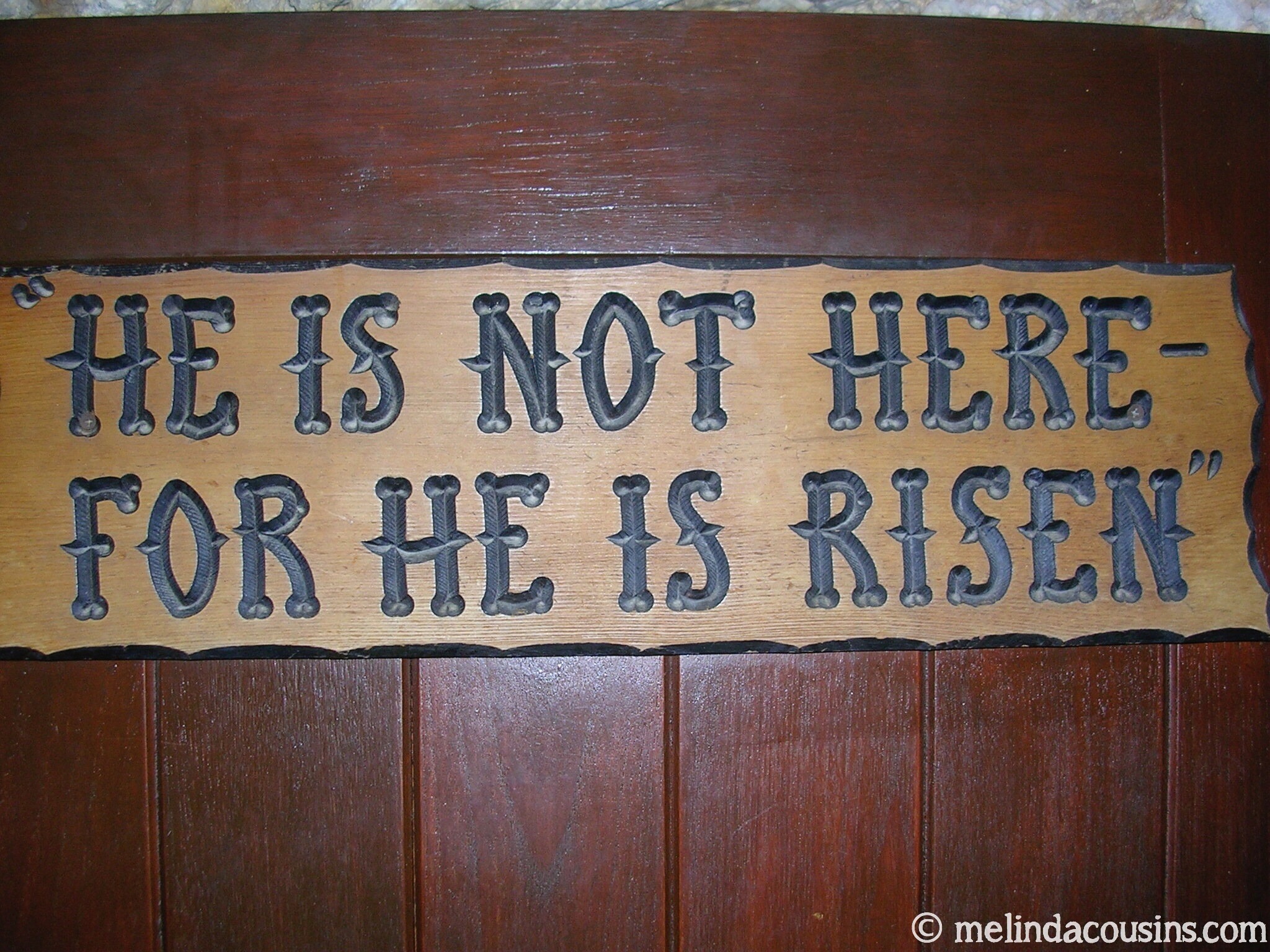
My favourite thing about this place has always been this sign on the door to the tomb. Jesus is not in this tomb, or any tomb. There is no need to locate a tomb for Him.
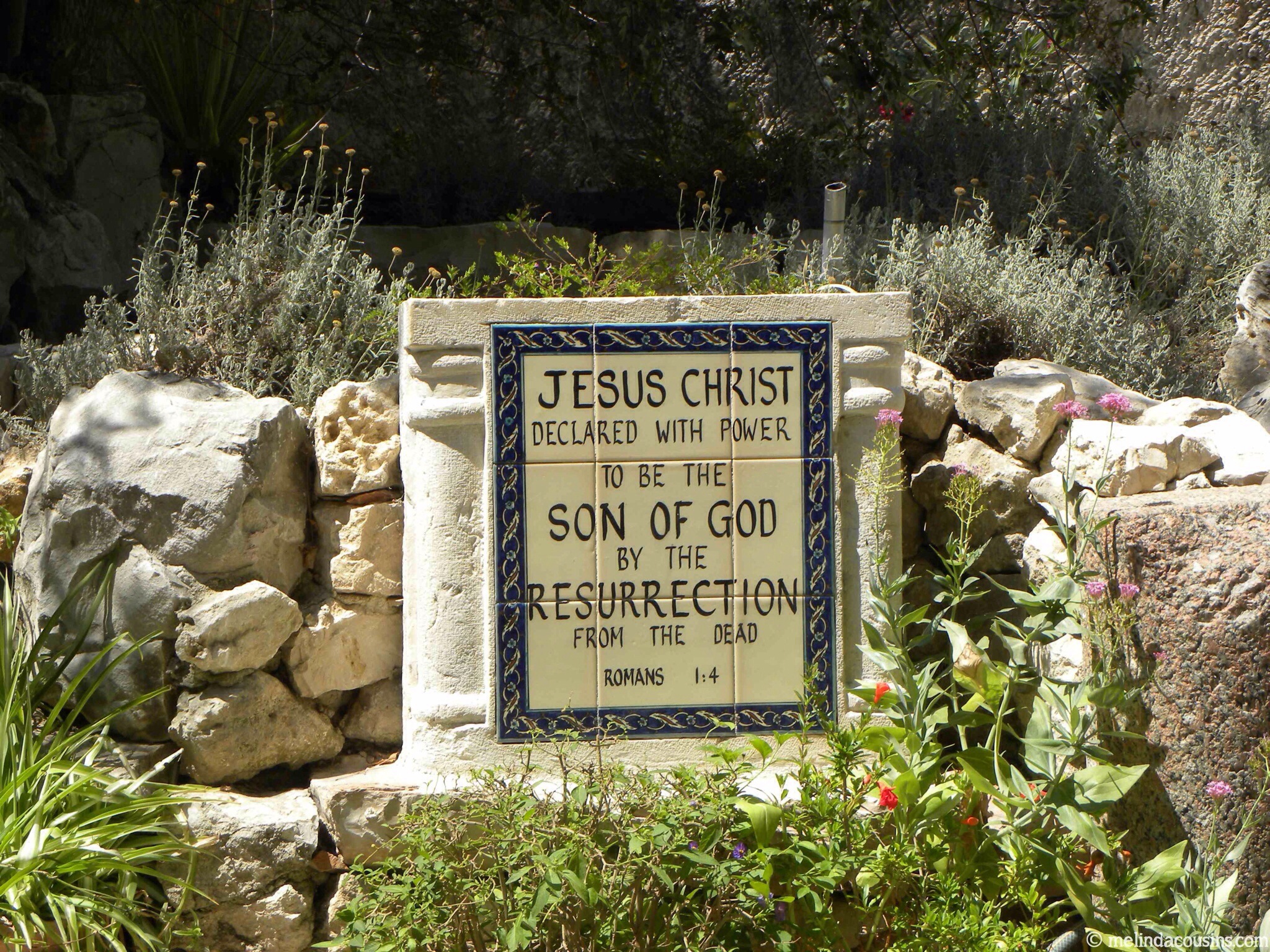
Sure, it’s lovely to have a place to visualise what it may have been like, and to sit and reflect and remember. But the resurrection of Jesus isn’t about a place and time in history. It is about a reality that changes our very understanding of history.
For many years, Christian apologetics focused primarily on the historical evidence for the resurrection. This is helpful and interesting, but if that is as far as we go, then we have missed the central point of what we are celebrating this weekend. Jesus’ resurrection from the dead is the breaking into our world of God’s kingdom and a whole new way of life. Because of Easter Sunday, everything is different.
To say, “I believe in the resurrection” is to say so much more than that I believe that Jesus rising to new life was a historical event that actually happened two thousand years ago. I believe it was and it did; but to believe in the resurrection, to put my trust in it, is to choose to enter into the new life that it makes possible. It is to believe that that kind of life is available to everyone here and now, despite all appearances to the contrary.
N. T. Wright says, “Jesus’ resurrection is the beginning of God’s new project not to snatch people away from earth to heaven, but to colonise earth with the life of heaven.” Resurrection life is life where miracles are possible, where justice is proclaimed, where renewal is experienced, where righteousness is lived out. It is the breaking in of heaven here on earth, and because of Jesus, it is available to us right here and now.
“This sorrow is crushing my life out. Stay here and keep vigil with me.”
“My Father, if there is any way, get me out of this. But please, not what I want. You, what do you want?”
“Can’t you stick it out with me a single hour? Stay alert; be in prayer so you don’t wander into temptation without even knowing you’re in danger.”
“There is a part of you that is eager, ready for anything with God. But there’s another part that’s as lazy as an old dog sleeping by the fire.”
“My Father, if there is no other way than this, drinking this cup to the dregs, I’m ready. Do it your way.”
“My time is up, the Son of Man is about to be handed over to the hands of sinners. Get up! Let’s get going! My betrayer is here.”
“Put your sword back where it belongs. All who use swords are destroyed by swords.”
“Don’t you realise that I am able right now to call to my Father, and twelve companies – more, if I want them – of fighting angels would be here, battle-ready? But if I did that, how would the Scriptures come true that say this is the way it has to be?”
“What is this – coming after me with swords and clubs as if I were a dangerous criminal? Day after day I have been sitting in the Temple teaching, and you never so much as lifted a hand against me. You’ve done it this way to confirm and fulfil the prophetic writings.”
(Words of Jesus in the Garden of Gethsemane. Taken from Matthew 26:36-56, The Message)
While in Sydney last week I had the opportunity to be in the live audience for the ABC’s Q and A program. I was in Sydney for the Rethinking Conference at which Miroslav Volf was speaking about faith and public engagement. I’m still processing my thoughts from the conference overall and am hoping to post some reflections in the next week or so, but I thought Volf’s appearance on qanda embodied the kinds of things he spoke about at the conference. I also thought there were some clear echoes of the way that Jesus engaged with people publicly.
So here are my observations of how Volf engaged, and the echoes I saw of Jesus. I think they present some important challenges to Christians today in the way we think and act when it comes to engaging with our wider community as people of faith.
1. Be surprising and confound expectations
When Volf was introduced by Tony Jones as a “Christian intellectual” you could hear the audience snicker. Many people in our culture have preconceptions about what Christians will be like in their public engagement and they are not usually very positive.
Although I and others I knew in the audience had submitted what we thought were thoughtful, broad-ranging questions for Volf, these were not chosen to be asked. Those questions that were chosen were generally on the narrow range of issues people expect Christians to want to talk about in public.
What I loved was seeing how Volf didn’t answer those questions as people expected him to. I think the Christian woman who asked him how to handle public ridicule got a bit of a shock when he pointed out that the persecution he suffered as a Christian in his homeland was not necessarily a bad thing for him, and that Christianity operates best from the margins.
I was reminded of Jesus, who was constantly confronted by people trying to put him in a box or wanting him to take their side or confirm their opinion. He didn’t do so, and usually left people shaking their heads and asking themselves questions like, “Who is this man?”
I wonder if too often people don’t want to hear a Christian perspective because they think they already know exactly what we are going to say?
2. Be able to compellingly articulate ideas on a broad range of issues
The first topic of the night was the arts. Volf was not included in this discussion until the very end, and it seemed he was not expected to know or care much about the topic. I thought his response to this issue set the tone for the whole program, as he was able to show other members of the panel that he had an intelligent perspective on an issue that they cared deeply about, and was able to demonstrate points of connection between their vision for the world and his. Again, he refused to let himself be boxed into only speaking on a narrow range of issues.
Similarly, Jesus didn’t just speak about the “spiritual” issues people expected him to care about. He spoke about paying taxes, and caring for the poor, and how to treat your neighbour, and living with fear and anxiety, and the need for imagination and purpose. He spoke about the social, economic, political and religious issues of his day. The message of good news he shared touched every area of people’s lives and makes a difference to their everyday realities.
Genuine faith should touch all areas of our lives too, and we should be able to find many areas where we agree with and support the perspectives of others.
3. Be gracious and engaging with those who disagree
This was on display from most of the panel all night. I wondered if Volf and Billy Bragg, a socialist and atheist, were put on the panel together in an attempt to create some controversy and drama. If so, it didn’t work, because they spent much of the night agreeing with each other, and when they disagreed they did so amiably. Volf didn’t argue or raise his voice, but showed that he was listening respectfully to the other voices in the conversation and seeking to understand where they were coming from. His tone was as important as his content.
Likewise, Jesus engaged people with love and respect, compassion and grace. He certainly had his moments of controversy, but these were usually with the religious leaders who were trying to put him into a box on “their” side! To “outsiders” he was known for his generosity and hospitality.
Too often Christians are seen to be argumentative, judgmental and hypocritical, and I think it is our responsibility to demonstrate the opposite attitude in the way we engage.
4. Leave people wanting more
Above all, I thought Volf didn’t say too much. He got more opportunity to speak than I was expecting him to, I think because of the way he engaged, but what he tried to do was raise questions and not give all the answers. At the end of the show, I felt he didn’t leave people wishing he had just shut up, but rather wishing they had heard more from him.
This reminds me of Jesus and his propensity for telling parables. These certainly didn’t tie up all the loose ends, but left people to ponder, question, think, and hopefully come back for more. When people asked him questions, he often didn’t answer, but left them with questions of his own.
Why do so many Christians feel like they have to say everything in one go? What are we afraid of if we don’t answer every possible question?
Response
Interestingly, most of the criticism I have heard of Volf’s qanda appearance has come from Christians who didn’t think he spoke clearly enough about the issues that they are passionate about. That he didn’t tie up the loose ends or say the things people were expecting him to say. Conversely, people who do not share his faith have generally seemed impressed with him.
This too reminds me of Jesus … the religious leaders of his day were angry that he didn’t meet their expectations, or answer all their questions, or condemn all their so-called enemies.
Perhaps there is something for all Christians to learn from. Our goal is not to preach to the choir, and perhaps the choir won’t be entirely happy no matter what we say. But if our goal is to invite those who do not share our faith to listen to what we have to share and consider it for themselves, then echoing Jesus in how we go about it seems like a powerful and effective idea.


















 Thinking Out Loud ...