Category Archives: Politics

Are we willing to question our assumptions about self-interest and economics?

It was announced this week that Poverty Reduction has been officially removed from the goals of Australia’s foreign aid. Many people have asked, quite fairly I think, if reducing poerty is not the goal of foreign aid, then what is? There are some possibly good answers to that question, but my fear is that the real answer is either self-interest, economics or politics (which may or may not all be one and the same).

Now perhaps it is naive and idealistic of me to think that it has ever been any way but thus. After last year’s election, the new federal government changed the status of AUSAid from a separate agency to part of the Department of Foreign Affairs and Trade, which seems a fairly clear indication that our aid goals are subservient to our political or diplomatic ones. It has recently emerged that our previous government gave specific amounts of aid to certain countries as “incentives” for votes to secure us a UN Security Council seat, which also makes a fairly blatant statement about our priorities.

It seems to me that the government knows that most people won’t care and will just accept that this is of course the ways things work. That a government’s role is always political before it is humanitarian. However, I find the priorities this reflects, and the assumptions it makes about what our community wants, quite frightening.

This week I also listened to a radio interview with the Premier and Opposition Leader in the leadup to our state election. They were asked about their plan for the state, and both gave answers solely about the economy. Now, I don’t want to deny that economics is important, but the assumption that economy = state is similarly one that I find problematic.

Surely there is more to what it means to be a community than how much revenue we can generate. Surely life is not valued in dollar terms alone. Surely we look for more in a government than simply who can make us have the most money in our pocket, like for starters, perhaps, oh I don’t know, … maybe who can govern well?!

Both these examples seem to be symptoms of a wider issue, where political decisions are being made on the twin assumptions that money is the only indicator of success, and that self-interest is the only motivation for people to act.

As a follower of Jesus, I do not share those assumptions and priorities. I follow the life and teachings of a Man who says, “Love your enemies, do good, lend, expecting nothing in return“(Luke 6:37-38) and “It is more blessed to give than to receive.” (Acts 20:35)

But I’d also challenge those in my community who do not share my Christian faith to consider whether those assumptions really reflect the kind of nation they want us to be. When we strip away the details and debates and niceties, is that really a bottom line we are comfortable standing for?

I am reminded again of a question asked by my favourite fictional politician, one which caused him to reflect on his assumptions and actions. The context is a conversation with one of his staffers about foreign aid, and aid in particular to the fictional nation of Equatorial Kundu.

President Bartlet: Why is a Kundunese life worth less to me than an American life?

Will Bailey: I don’t know, sir, but it is.

The West Wing, Episode 4 x 15, Inuguration: Over There

I worry that in Australia today not only does it seem we are unwilling to consider the answers to those kind of questions, but that apparently it doesn’t even occur to us to think of asking them.
No Room for Nuance

Recently a colleague commented to me (in person) about something I’d said in one of my blog posts. What I had written was a bit of a throwaway line, and while it wasn’t inaccurate, his point was that it needed greater nuance. I agreed, and mentioned that I am more than happy for those kind of things to be pointed out in comments – I love getting responses and differing ideas to what I share! But I take his point that in this format it can be very difficult to offer a nuanced perspective without being seen as disagreeing with or undermining the wider point.

One of the challenges with blogging is keeping posts short and readable. What gets sacrificed is the ability to provide nuance, details, explanations, caveats. Obviously this is even more so with platforms like facebook or twitter – it’s very hard to leave room for nuance in 140 characters!

When what is written on a blog or tweet is seen as a thought starter or a distillation of key ideas, and there is space to reply, comment, question and interact, it’s a great format. The problem as I see it arises when ideas expressed in these forms are taken as full and final statements, or when we assume that what someone has said is the only thing they think about a topic, or that they are not open to further discussion, or that new information would not change their perspective.

What really bothers me, however, is that this inability to leave room for nuance seems to be taking over in our national political climate. We demand full and final answers from our leaders, but we demand them in catchy sound-bites. In response we get slogans instead of policies, and leaders who are trying to govern by living up to those slogans.

Don’t we want the leaders of our nation to be people of nuance? People who change their mind when they receive new information and evidence, people who understand complexity and varying perspectives? People who grow and develop in their thinking and practice?

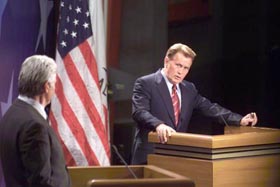
When our national political debate is reduced to un-nuanced, simplistic slogans, I think we all suffer. I am reminded of a quote from my favourite fictional politician,  given in the context of a political debate where people are looking for a “ten word answer” which can form the headline or sound-bite for the next news cycle.

“Every once in a while, every once in a while, there’s a day with an absolute right and an absolute wrong, but those days almost always include body counts. Other than that, there aren’t very many un-nuanced moments in leading a country that’s way too big for ten words.”

President Josiah Bartlet, “Game On,” The West Wing

Photo by Marcia Reed NBC, via The West Wing Continuity Guide (Unofficial)
Photo by Marcia Reed, NBC, via The West Wing Continuity Guide (Unofficial)

What do you think? How can we make room for nuance, whether on social media or in political discourse?

Can we please stop saying “Charity begins at home”?

Slide2I was recently forwarded an email by an older, distant relative complaining about the “injustice” of huge amounts of foreign aid being given to other nations while Australian pensioners struggle to get by. The closing words of the email, the “clincher” to prove the point that we should stop giving “so much” away, was that old saying, “Charity begins at home.”

Now the fact that my country has recently drastically decreased its foreign aid giving and completely abandoned the commitments we have consistently made over the last 30 years to play our part in addressing world poverty is a subject for another post! Today, I want to take a closer look at that supposed “trump card” saying.

Because I’ve also noticed its use on social media.  When someone advocates for greater foreign aid spending, it doesn’t take long for someone else to reply that it is more important to care about a group in need in our own nation, and to pull that same supposed clincher, “Charity begins at home.”

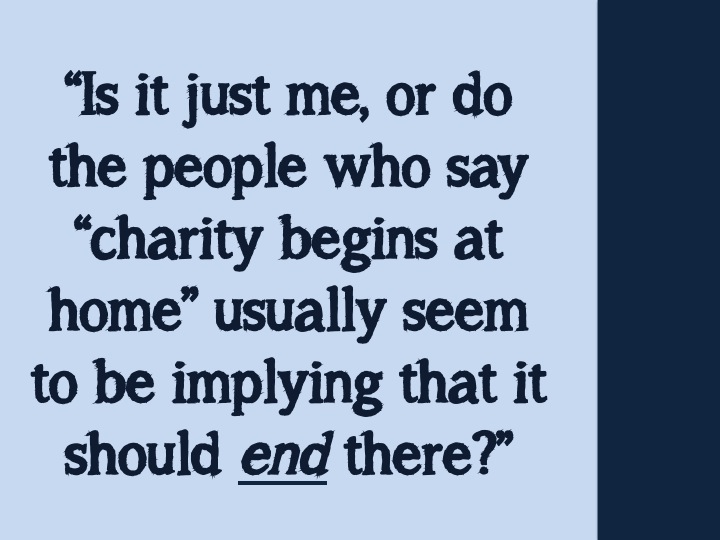
Is it just me, or do the people who say “Charity begins at home” usually seem to be implying that they think it should end there?

Here are my problems with the phrase ..

1. It’s a false dichotomy

Slide1The assumption seems to be that if I care about the global poor, I don’t care about people doing it tough here in Australia; as if I can only care about one thing at a time. But compassion is not a zero sum game.

I don’t believe I have to make a choice between the two and I don’t believe our nation needs to either. We need to stop assuming that standing up for one cause means you don’t care about any others.

2. It’s a false equivalence

I don’t want to get bogged down in ‘ranking’ needs, but to me there is a qualitative difference between people struggling to afford the costs of living in Australia and people dying of preventable diseases because they don’t have access to clean drinking water or basic sanitation in other parts of the world. I understand that I am generalising here, and I know there are people in my own backyard who are doing it tough, but mostly I think that our perspective is a little off.

Just for one example, the current Australian single pension is $751 per fortnight.  We have widely available free health care and education. On the other hand, 1.3 billion people in developing countries live on less than $7 per week, 768 million people do not have access to safe drinking water and over 1 billion have no access to basic sanitation.

In 2013, the Australian government spent 27 times as much on welfare/social security as it did on foreign aid. Whatever you think about the adequacy of Australian unemployment or pension rates, I think it is clear we are not comparing apples and apples here.

3.     The saying is not biblical

The first use of the phrase “Charity begins at home” in print is found in Thomas Browne’s 1642 book Religio Medici. It is now quoted as if it was gospel truth, often by Christians, and it is surprising how many people claim it is biblical or “based” on the Bible. It’s not.

In fact, my reading of Browne is that he is arguing against the saying. He uses it twice, in these two sentences:

  • “Charity begins at home, is the voice of the World…”
  • “That a man should lay down his life for his Friend, seems strange to vulgar affections, and such as confine themselves within that Worldly principle, Charity begins at home.”

 Read it for yourself and see what you think.

The Bible itself is pretty clear that we are called to love not just our family and our neighbours, but even our enemies. [Matt 5:44] The Old Testament laws laid a foundation for justice and generosity for the marginalised, including widows, orphans and foreigners. [e.g. Deut 15:7-11]

4.     That’s not what that proverbial saying means

More to the point, and I’m happy to be corrected on this, but my understanding is that the saying as it was originally taken up as a general English “proverb” was meant to refer to the fact that virtues are cultivated in the every day – that is, we learn to be compassionate and charitable people at home; that capacity within us as human beings begins to develop there, and then grows as we exercise it outside the home.

It’s worth noting that the word charity at that time didn’t mean what we usually assume it means today. It is the word the King James Version uses to translate the Greek αγαπη or love in the famous 1 Cor 13 passage. So “love begins at home” might be better, meaning again that ideally we learn love from our families so that we can then exercise it in our interactions with others outside the home.

What we usually mean by charity today (donating to the needy) actually doesn’t make any sense with the saying – providing for the welfare of the people in your house is by definition NOT charity!

So … this is my question for today, and I’m aware that it is idealistic and unlikely … but whatever debates we have about generosity, global poverty, foreign aid, and caring for the needy at home, can we at least stop pretending that the saying “Charity begins at home” is some kind of magic bullet that trumps all rational discussion?!