Category Archives: Questions

So many words. Who is really listening?

Listening - FDR Memorial

There has been so much going on in the world over the last few weeks. Gaza. Israel. Ukraine. MH 17. Iraq. Syria. Nigeria. Nauru. I’ve found myself in the paradoxical position of feeling lost for words … and yet wanting to say so much.

But when I scroll through my facebook or twitter feeds I see link after link to articles and opinion pieces and blog posts. So much virtual ink being spilled. So many words. So many people speaking.

It makes me wonder.

Who is listening?

Certainly not the people commenting on many of the opinion pieces or blog posts I have read. Mostly they seem to be talking past each other, in a hurry to accuse each other of being on the wrong side, or of saying or thinking the wrong thing.

So many strong opinions. So many assumptions that one comment made implies a whole host of other opinions and positions. So many implications that there are only two sides to an issue and one is completely right and the other completely wrong. So many black and white pronouncements. So many accusations.

Yes, I have informed opinions about what is going on in Gaza. Yes, I have strong feelings about what is happening to the Christians in Iraq and how it is (or isn’t) being portrayed in the mainstream media. Yes, I have thoughts about the shooting down of MH 17 and how our country has responded to it. Yes, I have passions about how the Australian government is talking about and treating refugees arriving by boat. Yes, I am still concerned about the missing kidnapped girls in Nigeria and violence against women everywhere. Yes, I could go on.

I could write post after post about each of those situations. I have tried to educate myself about each of them. I have some experience with the issues involved in some of them. I hope I bring a thoughtful, theological perspective to bear on them.

But before I say another word about them, I have two questions. One is for you and the other is for me.

First, to you. Would you listen? Would you really listen to me? Or would you use what I said to judge me and pigeonhole me and decide whether I am on “your side” of an issue or not? Would I simply confirm what you already think, or lead you to dismiss my thought processes because you have already decided you disagree with my conclusion? Is there any chance that something I say could change how you think about these situations? Because if there isn’t, you cannot hear me.

Second, to me. Have I really listened? Before I speak, have I taken every opportunity to really hear those who are directly affected by the situations the rest of us are opining about? Because I fear that what I see too often is people like me, people in comfortable, wealthy, educated, privileged positions, pontificating about situations in which real people are suffering. How many of them have I listened to? I mean really listened to. How many of them have I greeted by name, sat down with, and genuinely sought to hear?

I was wondering the other day how different the internet would be if there was a rule that you could only write a blog post or an opinion piece about a situation in the world if you were actually on a first name basis with a real person living in that situation and had listened to what they have to say. No doubt that’s an idealistic, unworkable idea, but it’s one that challenges me and keeps me asking questions rather than making statements.

The apostle James spoke these words of wisdom nearly two thousand years ago.

“My dear brothers and sisters, take note of this: Everyone should be quick to listen, slow to speak, and slow to become angry.”

What would it look like for us to listen, really listen, to these words in the way we respond to the crises around our world? Do you think perhaps it could somehow make a difference?
How does the church respond to #YesAllWomen?

I remember the conversation so vividly. I was seventeen, it was a Saturday morning in summer, and our youth group was clearing the garden of an elderly church member. Taking a break, I found myself sitting cross-legged in a circle on the grass with five other young women around my age. I don’t remember how the conversation started, or who said something first. It wasn’t a topic we had talked about before, nor was it one we ever mentioned again. But someone was brave enough to share her experience of being groped by one of the guys in our group – not asked for, not consented to. Someone else told a similar story, then someone else. And for the first time in my life, I realised that this kind of thing wasn’t something that had just happened to me, or to a couple of us, or even to most of us. It was the experience of us all.

Every. Single. One.

So when #YesAllWomen started trending on twitter last weekend, I was immediately taken back to that conversation all those years ago. And I was reminded once again that my group of friends were not an anomaly, but that this is the common experience of everyone who grows up female in our society.

I realise that the immediate context for the twitter conversation was a specific instance of violence, and I realise that not all men are perpetrators of harassment and violence against women, but it exasperates me that I have to name those as caveats, because as far as I can tell, no one is suggesting otherwise. But too often this kind of conversation is derailed by those kinds of responses. No, not all men are like this. But when enough are to make this the experience of yes, all women, then surely it’s time to have an open conversation about it.

For Christians, it is easy to think these things happen to women “out there,” but not to the women in your church. That is a mistake. I could tell you story after story of women I know, but part of the point of #YesAllWomen was to hear women speak their own experiences. And so while I have hesitated to do so, for any number of reasons, let me tell you just a few of mine.

The guy in my youth group who repeatedly grabbed my breasts while playing rough games. The young man who heard me speak on a Christian radio program and emailed me to tell me what he would like to “do to me.” The man who got my number from the church bulletin and phoned me in the middle of the night with sexually explicit threats. The “sweet old man” at church who backed me into a corner and shared details of the dreams he had about me while stroking my hand.

I’ve never told anyone most of those stories before. They are awkward and embarrassing and to be honest there is still a part of me that feels like saying them out loud will make people think I’m making a big deal out of nothing. But the truth is my experience is the same as nearly every woman I know. This is the culture in which we live.

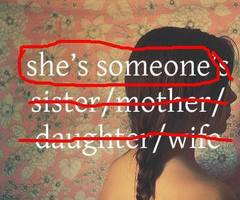
She's Someone

And all of these stories I told took place within the context of the church. The community called to model the Kingdom of God, where peace and justice and love are to be demonstrated. If anywhere should be a place safe from harassment and violation, surely it should be here.

So how does the church respond to the reality of a culture which is marked by everyday sexism and sexual harassment of women? Where all kinds of bad behaviour is minimised as “boys being boys” and women are expected to laugh it off or be flattered? Where many women, myself included, are afraid of being labelled strident trouble-makers for even mentioning this topic?

I’ll be honest. I’m a leader in the church and I struggle to know how to respond to this. I’m a woman in the church and most of the time I try to forget that this is how it is.

But maybe, like the twitter conversation, we need to start by being frank and open about this. How can we even begin to reach out to our community with a message of hope and healing, if we are not willing to name the reality of our experience? If we are not willing to call out what Tara Moss eloquently called the “toxic silence”? (for which she has since received rape threats).

I would say to pastors and preachers, leaders in the church, both men and women, read the #YesAllWomen conversation, and as you read, picture the women in your church speaking. How will that reshape the way we preach, teach, and care?

Beyond responding within our own community, I love the question Suzanne Burden concludes her excellent blog on this topic with:

“What if the Church started leading the way culturally in decrying injustice against women and raising them up as image-bearers of God for his good purposes?”

Let me end by saying I don’t know what happened to all of those girls in that circle that summer morning. I do know that by the time we were 20, one of the six had been raped and another physically assaulted, both by young men they met at church. The one in three statistic borne out in reality, not “out there,” but in our own community. How is the church responding to that?

A Tale of Two Disappearances: Should it matter if they could have been us?

Over 200 people disappear in the middle of the night. How does the world respond? It seems that it depends. If the 239 people are tourists and business people on an aeroplane, the response is blanket media coverage for days on end, and millions of dollars and international cooperation in organising a weeks-long search, even though it has been clear for most of that time that there will be no survivors.

If, on the other hand, the 284 people are teenage girls from an African Muslim nation, it seems that it takes weeks for most of the world to even hear about their plight, desperate persistence by their families, and the beginnings of an outcry on social media before the mainstream media and governments even begin to mention the disappearance, even though it is very clear that these girls are very much alive and are being bought and sold as chattel.

I’ve been sickened and heartbroken over the news of the horrific kidnapping of nearly 300 16-18 year old girls from their school in Nigeria in April. It’s incredibly difficult to know how to respond. And like many others, I have found it difficult not to compare the response to this event to the response to the disappearance of flight MH370 in March.

The difference in news coverage has been striking. Our Australian Prime Minister has made numerous public statements about his dedication to the search for the wreckage of MH370, yet as far as I can see has made no public comment about the kidnapping and trafficking of these children in Nigeria. But I don’t just want to blame the government and the media. Often times they are simply focusing on what they think we want to hear about and/or care about.

And this raises for me some very tough questions about what we consider important and why. About whose lives are valuable and why.

Is it because these victims are black, or because they are female, or because they live in a Muslim country, that their story has not been treated as prominently? Perhaps. But I wonder if there is something else at work – something that lies within not just our governments, and our media, but in each of us.

I wonder if it boils down to this: “It could have been me.”

When we hear of a plane disappearing, most of us immediately think of our own air travel. It’s a part of our everyday experience, something we rely on and assume we can do freely without fear. We know there were four Australians on MH370, and so we relate to them because in many ways, they could have been us, or our family members. Perhaps it makes us that little bit fearful next time we board a plane, reminded of our own mortality and the risks inherent in our comfortable Western lives.

But militants kidnapping children because they are attending school? That is so far outside our experience, and so unlikely to ever happen to us or anyone we know, that we don’t have to worry about it. We can’t relate.

It seems to me that often we care more about people who are like us. And I wonder if it’s not necessarily because they are like us, but because subconsciously we think they could be us? So our compassion is in some ways selfish, because it is about our own fear, or our fear for our own children, rather than for the other person.

I’ve heard it said that 100,000 deaths in a remote third-world country = 1,000 deaths in a place you’ve heard of = 100 deaths in a country you’ve been to = 10 deaths in your own country = 1 death in your own neighbourhood. Is it simply about proximity, or is it that it’s “too close to home” meaning something like “that was very nearly me”?

A few years ago I was at a Women’s Retreat. Our guest speaker had recently returned from working in Niger, one of the poorest countries in the world. She told story after story about children dying of malnutrition and starvation, of preventable diseases and lack of access to basic sanitation. Then, just before lunchtime, someone received a copy of the local paper, and read a story about a three year old child who had drowned in a backyard pool in our city. As I went into lunch, I couldn’t help notice that the major topic of conversation around the tables was about the news story. How tragic and awful it was for the mother, the family, of that child. And it was. But no more tragic and awful than the experience of hundreds, thousands, of women in Niger who we had been hearing about all weekend. Why did one story grab our attention so much more than the others? I can only answer that it was because deep down, perhaps without even recognising it, many in the room were thinking, “That could have been my child. That could have been me.”

I hesitate to tell that story, because I don’t want to seem judgmental of others when I am often exactly the same. But I felt like I learned something very profound that day. It is hard to care for people when their experience does not touch our own lives in some way. Deep down, do we categorise some people’s experience as different to ours, and some people therefore as “other” to us, so that we can seemingly justify to ourselves not caring about them in the same way?

These kinds of questions make me feel rebuked, and I kind of hope you do too. I don’t want to be a person who cares about things only because they have some connection to my own self-preservation and self-interest. I want to be a person of compassion, speaking out against all injustice, especially when it is so outrageous, so disgusting, so far removed from my understanding of humanity, that I still can’t quite believe it could happen to anyone.

In terms of the Nigerian girls, what can we do?

For starters, we can start speaking up. We can take every opportunity to ask our government and our media to speak up too. And we can start speaking the truth about what has happened. Recent media reports say these girls are being sold “as brides,” accepting the language the perpetrators have used for what they are doing. That is watering down the true horror. They are being trafficked as sex slaves. Let us name this evil for what it is and stand against it.

We can educate ourselves about this situation, and support organisations that are seeking to work against injustice in places like this. This article on 6 Things You Should Know About Nigeria’s Mass Kidnappings is a good place to start. If you want some much deeper context, and are willing to engage with some harrowing truths, this working paper on Boko Haram and Gender Based Violence is worth a bit more time.

And we can pray. I was so pleased to read this article at A Church for Starving Artists which lists the names of many of the missing girls, and encourages readers to pick just one name and pray for that girl. Let’s make this personal. Let’s not succumb to the temptation to think of these girls are “other,” but let’s start treating them as our own children. Because, humanity, they are.