Tag Archives: Bible

Today is a Nice Day to be in Baltimore (at SBL)

It’s Monday but rather than wishing I was somewhere else, I am somewhere else. Baltimore is a pretty city with a nice harbour and some great historical buildings, although it has been a little chilly for my liking the last couple of days! But I’m not here to see the sights, so this isn’t really a travel post.

Baltimore
Baltimore

I’m in Baltimore for the annual meetings of the Society of Biblical Literature. It’s hard to describe, but try to imagine 10,000 people who are all studying or teaching the Bible, theology, or religion coming together for four days to share and discuss new ideas and happenings. Kind of like Comic-Con for Bible nerds if that means anything to you. This is my second time round after Chicago last year and I’m really enjoying it again. It’s pretty amazing to find yourself in a place with a whole bunch of other people who love the things that you love, and to talk to just a small sampling of them.

So what am I loving about it?

There are hundreds of different sessions and thousands of papers presented. I’ve been to presentations where I learned new ways of thinking that stimulate my own ideas; sessions where I wasn’t even familiar with all the words the speaker was using (even though they were actually in English); and even the very occasional session where I was thinking, “I actually already knew that!” As well as those in my areas of research interest, I’ve also attended other sessions on interesting and thought provoking topics I’ve never thought about before.

There’s also a book stall of immense proportions with significant discounts on US prices (so a lot less than Australian prices), so I may have bought a book or twelve.

Books

There’s also a bit of “theological celebrity spotting” going on. Yesterday at the book stall an older man and I went to pick up the same book at the same time. As we both laugh and apologise, I sneak a look at his name tag. Yep, that’s Erhard Gerstenberger, German Old Testament theologian whose commentary on Psalms I just finished reading a couple of weeks ago. Last night I went to hear NT Wright speak on his new book (his sixty-somethingth) Paul and the Faithfulness of God. It was kind of like getting the cliffs notes version so now I don’t feel the pressure to read the whole thing (sshh, don’t tell Stephen Spence I said that :)) Tomorrow I have the opportunity to have brief conversations about my PhD with both Tremper Longman and Walter Brueggemann. My only fear is that I’ll be too “starstruck” to form coherent sentences, which would make it rather difficult to sound like a good academic!
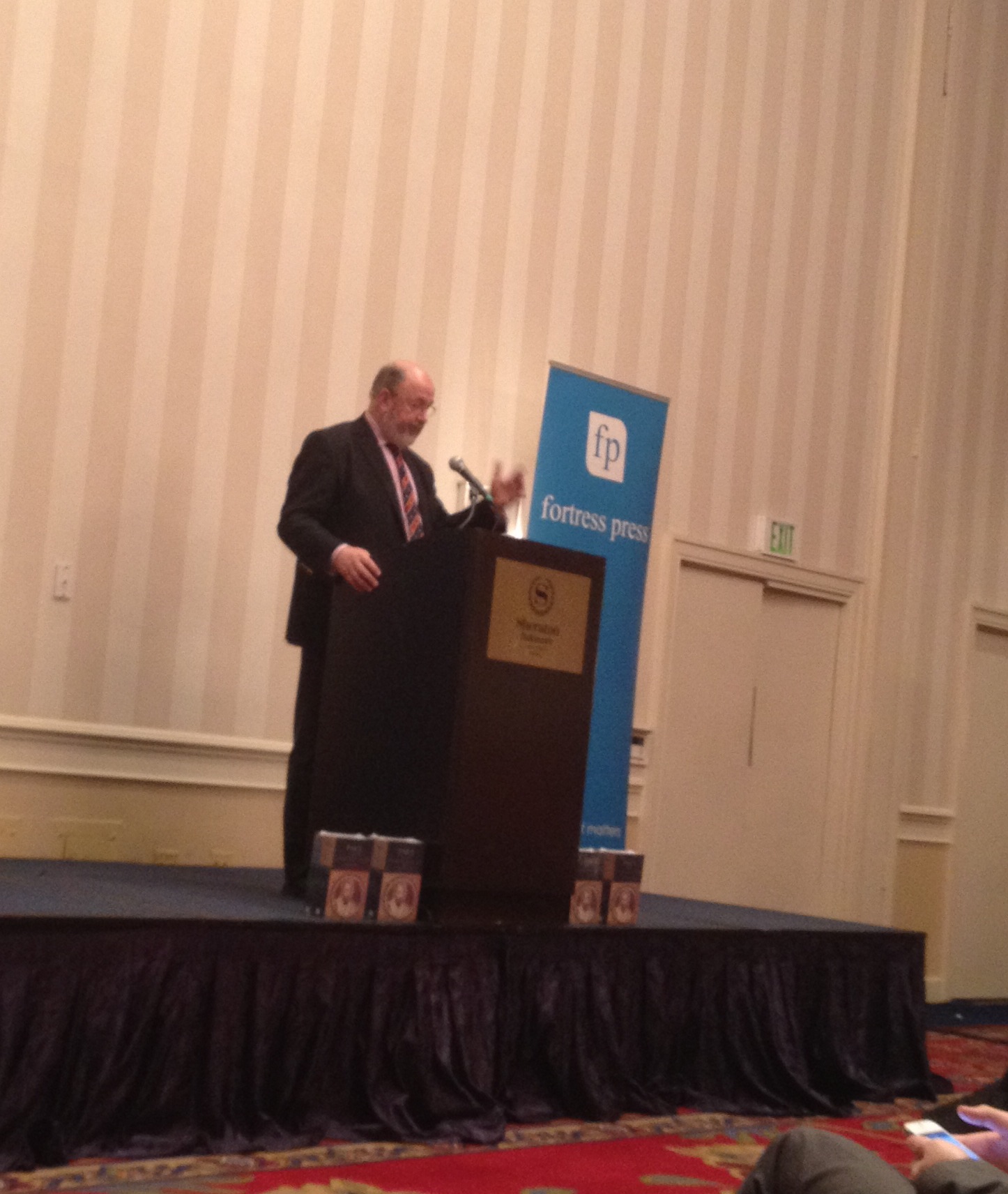
NT Wright giving an overview of his new book

Yes, I’m name-dropping, but I’m guessing they are not names which mean much to most people. The exciting thing is meeting the people who are doing what you want to do, those who have trod the path you hope to tread, who have made a significant contribution to an area of study and vocation you dream of making some kind of small difference to as well. I’m particularly inspired by those who are thinking and writing at this scholarly level but maintain their passion for making sure their work serves the local church.

So, what can I share that I have learned here?

My tip to any of you is this: if you work, study, or have a personal interest in a particular area and there is a big gathering of people who have that same interest, I’d encourage you to aim to get along to it at least once. It’s a really wonderful thing to find yourself caught up in realising that you are part of something much bigger than yourself, to be affirmed that you are not alone in doing what you are doing (or in caring about what you care about), and to be inspired and equipped to keep going and do more!

And if you don’t know how to find other people who love what you love, or you don’t yet know what that thing you really love to do is, make it a priority to find out! Find something that you really love to do, that you feel like you were created to do, and pursue it with all your heart!

I’m not exactly sure where this time of biblical research is taking me, and I remain passionate about both theological teaching and also local church ministry so who knows how that will all come together … but I’m enjoying the journey and trusting that it is as significant as the destination yet to be revealed. To paraphrase one of the speakers I heard yesterday, “God is as interested in our wrestling to get to where we are going as He is in that we get there.”

The Sacredness of Questioning Everything

The title of this post is the name of a book by David Dark which someone gave me a few years ago. It’s quite a good book but I like the title even more so. Because I love asking questions. Not because I’m constantly seeking to challenge or undermine others, but because it helps me think about things in new ways. Questions open possibilities and ideas. Questions make me reconsider my assumptions. Questions invite people to join me in exploring and wondering and imagining.

One of the guys I used to work with would sometimes get frustrated when he felt like all I had were questions without any answers. And I can understand that frustration. I don’t want to come across as a Negative Nellie or a Doubting Debbie! I know I need to keep learning the difference between questions which are critical in the sense of expressing disapproval and questions which are critiquing in the sense of analysing options and possibilities. I want to ask questions that inspire rather than judge.

But I also know that too often Christians can seem to present themselves as people who have all the answers, as if when you choose to follow Jesus suddenly life gets all wrapped in a nice big bow and everything becomes simple. That hasn’t been my experience. For me part of the journey of discipleship has been learning to ask more and better questions.

Jesus asked questions a lot. Seriously, have a look at the Gospels. He asked questions all the time! It was a key way He taught, it was usually the way He engaged with people who came to Him with questions, and it was often the way He got His disciples to imagine what life in the kingdom of God might look like.

I find some of the best questions I ask are the ones I ask of myself. Questions like: What am I afraid of? What do I really want? What am I really trying to say? What is stopping me from doing what I know is right? What if I believed I could make a difference here? Why do I think that way?

And other times the really good questions are the ones God asks me. Who do you say that I am? (Luke 9:20)  What do you want me to do for you? (Matt 20:32) Will you really lay down your life for me? (John 13:38) Those are the ones I’m really trying to work on answering well.

A Better Metaphor for the Bible?

I ran a seminar on the Bible at a recent conference and took with me a glass bowl in which I placed pieces of paper with individual verses from the Bible written on them. I asked each person to take one and that could be an “inspirational word” for them that day. A couple of people were quite encouraged by what their piece of paper said. Most were simply bemused; some even amused. Verses like “He fled naked, leaving his garment behind” (Mark 14:52), “I wish they would castrate themselves” (Galatians 5:12), “Jahaz, Kedemoth, Mephaath” (Joshua 13:18), or even just “He said” (Job 3:2) don’t exactly lend themselves to being emblazoned on inspirational posters.

My point was not to denigrate the Bible. I love the Bible. I have devoted my life to teaching it. But my point is that many Christians treat the Bible as if it is a kind of “promise box” which contains these individual nuggets of wisdom and inspiration called “verses.” We treat it quite flatly, as if each one of them should work in exactly the same way. No wonder so many of us struggle to read it! And no wonder our society sometimes ridicules Christians for following it if we have given the message that that is what the Bible is and how it works. Because it is impossible to read the Bible that way, and I would suggest it is impossible to live in response to the Bible if we are attempting to live out of that metaphor.

For starters, the Bible isn’t made up of verses. It is made up of books (and letters and collections of poems and laws and more.) Books are written as wholes and designed to be read as wholes. Imagine taking To Kill A Mockingbird or A Tale of Two Cities and cutting them into individual one-line pieces and expecting them to impact you in the same way the whole book does. Books just don’t work that way.

The verse numbers we are familiar with were first included in translations of the Bible in the 1550s. And they are very helpful! If we want to study or discuss the Bible in community, it works really well in our literate culture to be able to look up a numerical reference to make sure we are all on the same page. But they were never designed to completely change the way we think about what the Bible is.

So what is a better operating metaphor for the Bible? As a collection of books spanning a variety of types of literature and historical periods, the metaphor that I find resonates well is that of story. The Bible is God’s story; a story in which we are invited to participate. Individual parts of the Bible contribute to that overarching story in a variety of ways. The historical books tell us about the God who made Himself known to different people in different times and places and through them we learn about the God who makes himself known to us in our time and place. The prophets and poets proclaim the words God spoke to His people and the words they spoke to Him and through them we can hear and speak in similar ways. The Gospels reveal to us Jesus Christ: who He is, how He speaks into the world, and His saving death and redemptive resurrection. The letters of the early church reveal the way people applied their faith in Jesus to the realities of their lives and again enable us to do likewise.

One of the dangers of using “story” as our metaphor for the Bible is that sometimes people hear the word story and immediately think fiction. That is not at all how I am using the word. One of my favourite things to do is listen to other people’s stories and share my story and see how they interact. These are not fictional! Rather, telling our stories is the way we relate and engage in community. We live out of stories. And so I love the picture that God invites us to live out of His story.

NT Wright does a much better job of explaining this metaphor than I ever could. He speaks of the Bible as an unfinished drama, one in which we are given the first few acts and the concluding scenes but invited to improvise our own part. This article on the authority of the Bible, and particularly the section on Authority of a Story, is well worth a read if you want to pursue this idea.

But I’ll conclude with another picture. Last year I had the opportunity to visit a church in a Northern Territory Aboriginal community. An indigenous artist has drawn nine paintings which together tell the story of the Bible. They hang on the walls of the church to be “read,” much like the original purpose of the stained glass windows in many European cathedrals. And when the community of God’s people gather in that place, they are literally gathered  within God’s story. That is another metaphor that really resonates for me. The church is constituted in the midst of God’s story. The Bible is not a collection of verses we can pull out as daily motivational sayings, nor wield as weapons in some kind of war. It is the story which gives us life as God’s people and it continually invites us to enter into and embrace the part our own stories can play in His.

Aboriginal Art Revelation